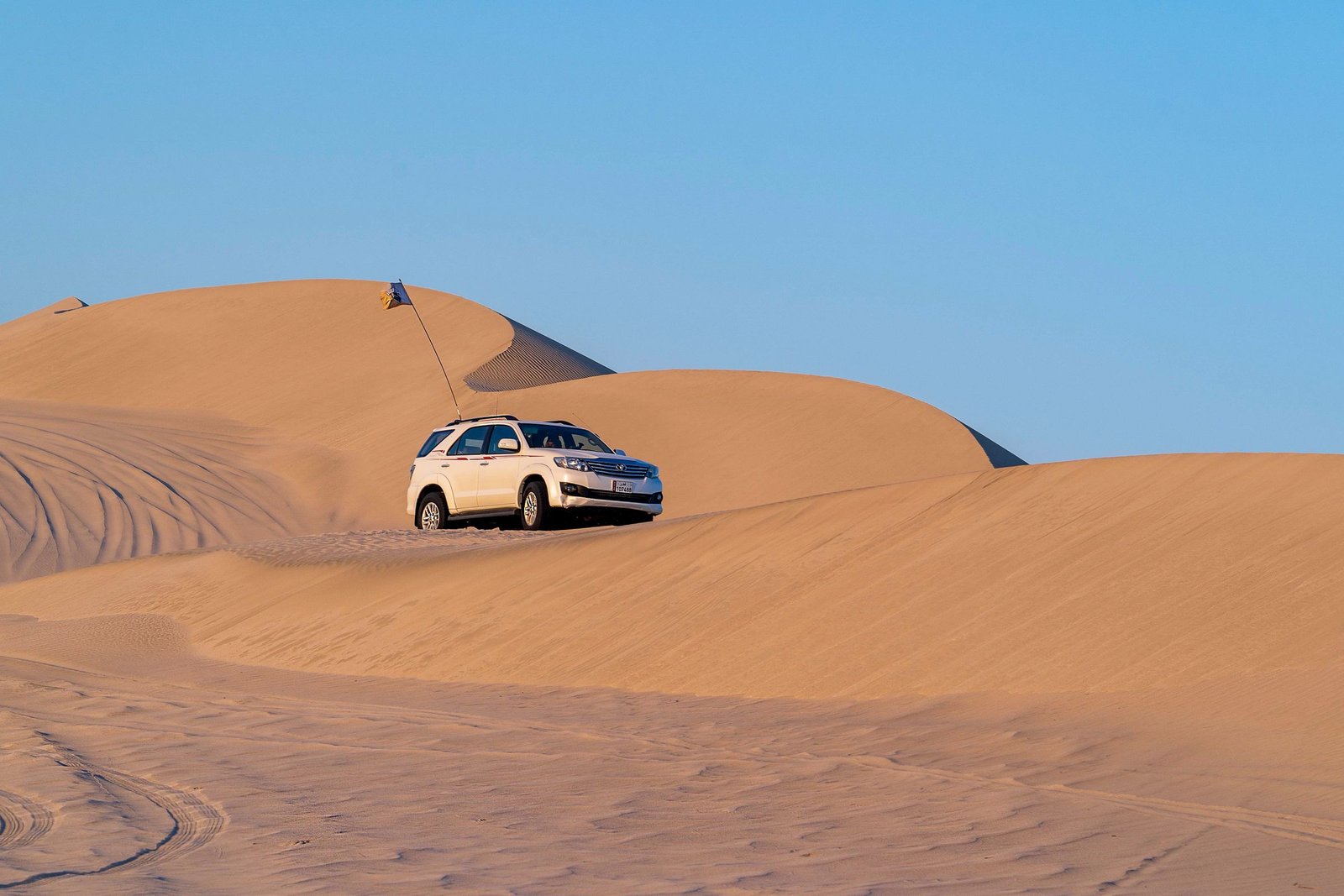
Driving on sand is one of the great pleasures of life in the Gulf, and one of the easiest to get wrong. Sand behaves unlike any road surface. It shifts, softens in the heat, hides steep drops behind gentle crests and can swallow a heavy vehicle to its axles in seconds. The good news is that a few simple principles make a huge difference, and most of them are about patience rather than bravery.
This guide is for beginners. It is not a substitute for going out with experienced drivers, which is the single best thing you can do, but it will help you understand what they are doing and why.
Never go alone
The first rule of desert driving is the most important: never drive into the dunes with a single vehicle. Even experienced drivers get stuck, and a second vehicle with a tow strap turns a crisis into a ten-minute inconvenience. Go with at least one other car, ideally with a driver who knows the area, and tell someone at home where you are going and when you expect to return.
Many clubs across the Gulf organise beginner trips with marshals who lead and sweep the convoy. Joining one is the safest and most enjoyable way to start.
Choose the right vehicle and check it
You need a proper four-wheel-drive vehicle, ideally with low-range gearing, decent ground clearance and all-terrain tyres. Before setting out, check the basics: tyres, coolant, oil and the condition of the battery. Heat is hard on vehicles, and the desert is the worst place to discover a weak hose.
Lower your tyre pressure
This is the most important technical step. At road pressure, tyres are hard and narrow, and they dig into soft sand. Lowering the pressure lets each tyre spread and float on the surface, greatly improving traction.
As a general guide, many drivers lower their pressure to around 15 to 18 psi, roughly 1.0 to 1.2 bar, for soft dunes, though the right figure depends on your vehicle, tyres and load, so follow the advice of experienced drivers and your tyre manufacturer. Use a proper gauge, and lower all four tyres evenly.
Just as important: reinflate before returning to the road. Driving at speed on underinflated tyres can overheat and damage them. Carry a good portable compressor.
Use the right driving mode
Engage four-wheel drive before you need it, not after you are stuck. On soft sand, many vehicles do best in low range or a dedicated sand mode, which gives more control and torque at low speeds. Switch off or adjust traction control if your vehicle's handbook recommends it for sand, because some systems cut power just when you need it.
Momentum is everything
On sand, momentum is your friend and the brake pedal is not. Keep a steady, moderate speed and smooth throttle. Sudden acceleration spins the wheels and digs holes; sudden braking pushes sand in front of the tyres and can stop you dead.
If you feel the vehicle slowing in soft sand, ease off slightly and keep the wheels turning rather than flooring the throttle. If you stop moving forward, stop. Spinning the wheels only buries you deeper.
Climbing and descending dunes
Approach a dune straight on, with enough momentum to reach the top but not so much that you fly over it. Near the crest, ease off the throttle so you arrive slowly. You cannot see what is on the other side, and many dunes have a steep drop, called the slip face, immediately beyond the top.
If you fail to reach the top, do not try to turn around on the slope. Reverse straight back down in gear, keeping the vehicle pointing directly up and down the dune.
When descending a steep face, go straight down, in a low gear, letting the engine control your speed. Use the brakes gently, if at all, and never turn across a steep slope. A vehicle sideways on a dune can roll.
Getting stuck, and getting out
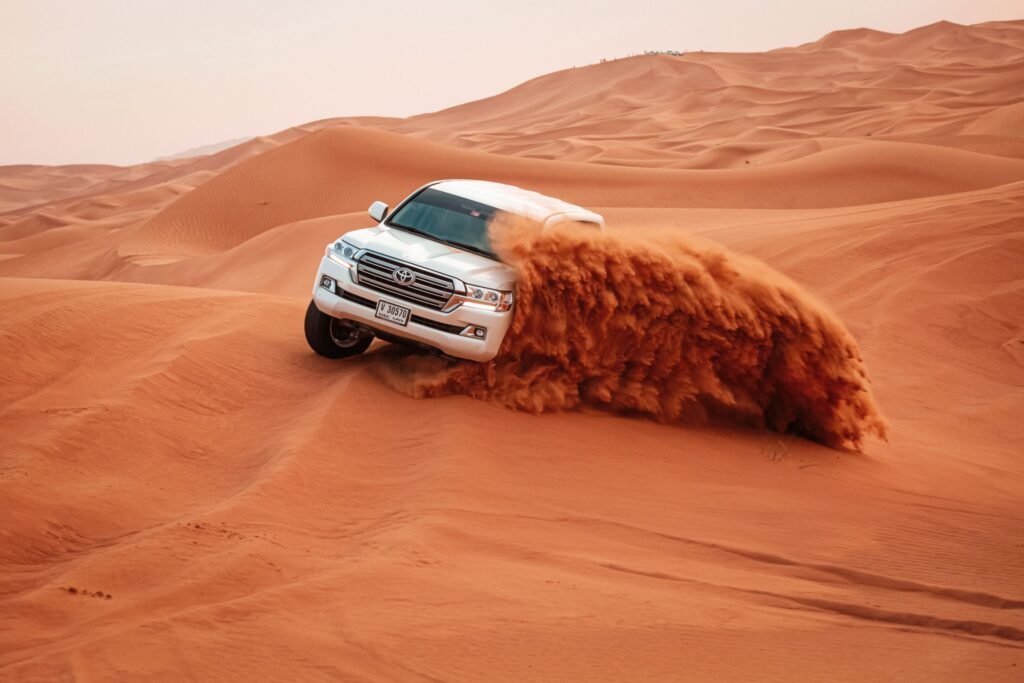
Everyone gets stuck. When it happens, stop accelerating immediately. Step out and look at the wheels. Often, simply clearing sand from in front of the tyres with a shovel, lowering the pressure a little more and reversing gently along your tracks will free the vehicle.
If not, use recovery boards wedged under the tyres, or a tow from another vehicle using a proper recovery strap attached to rated recovery points, never to a tow ball or bumper. Keep everyone well clear during a recovery, because a strap under tension stores enormous energy.
A basic recovery kit includes a shovel, recovery boards, a kinetic recovery strap with soft shackles, a tyre gauge, a compressor, a first-aid kit and gloves.
Heat, water and timing
Plan around the heat. Sand is firmer in the cool of morning and late afternoon and softest at midday, so early and late trips are easier as well as more pleasant. Carry far more water than you think you need, at least several litres per person, plus extra for the vehicle.
Carry enough fuel to return comfortably, a charged phone and, ideally, a GPS device with your route. Mobile coverage can disappear quickly in the dunes.
Respect the land
Drive only in areas where off-road driving is permitted, stay on established tracks where they exist, and avoid vegetation, which holds the dunes together and supports wildlife. Take every piece of rubbish home.
The reward
Done well, a day in the dunes is unforgettable: the shapes of the sand changing with the light, the silence when the engines stop, coffee poured as the sun goes down. Learn the basics, go with people who know, and the desert will repay you many times over.