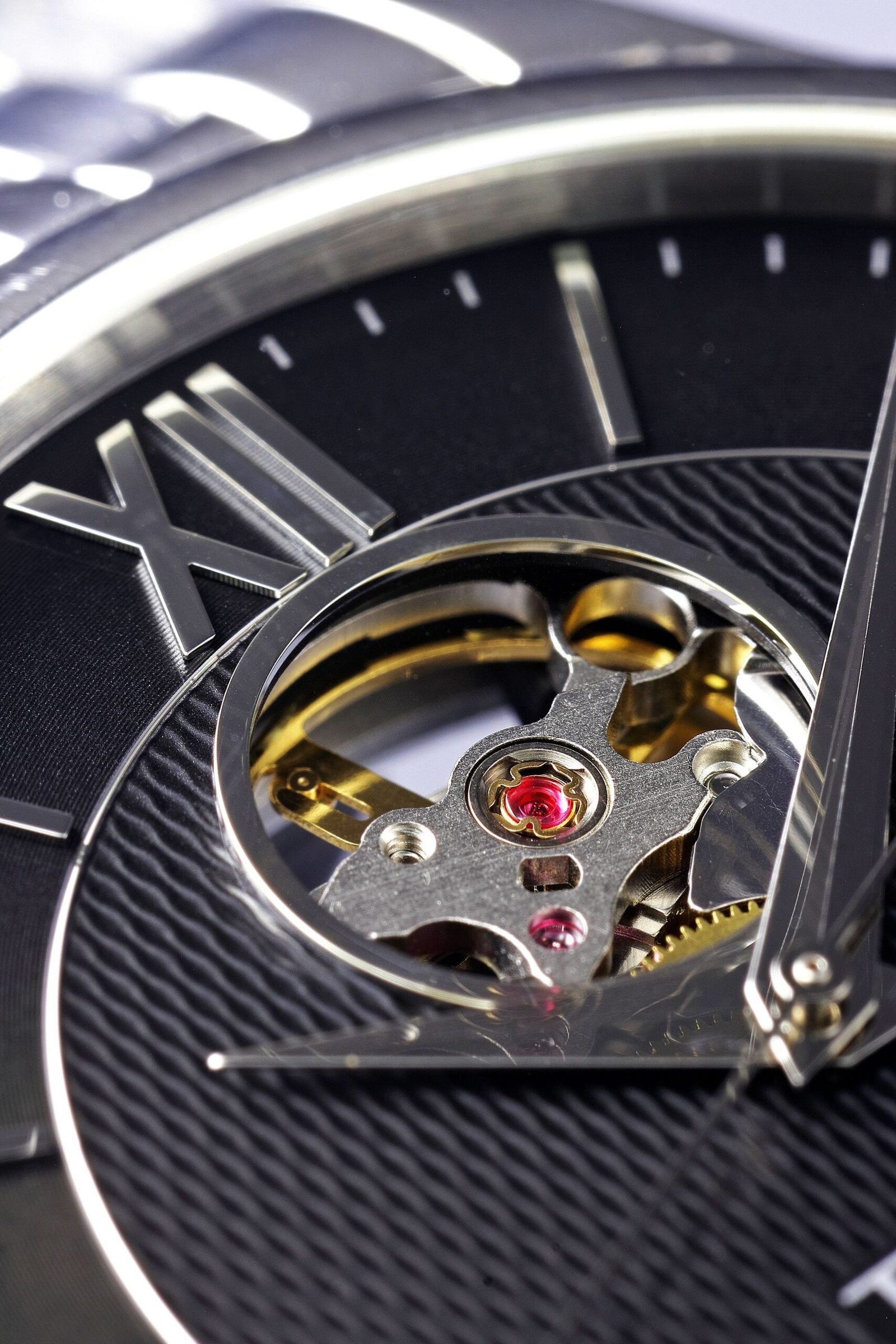
Hold an old pocket watch with a white enamel dial up to the light and you will notice something that printed dials rarely have: depth. The white seems to glow from within, the black numerals sit on its surface like ink on porcelain, and after a hundred years or more the colour has not faded at all. That is the quality of grand feu enamel, and it is why watchmakers still go to extraordinary lengths to make it.
Glass on metal
Enamel is glass. It begins as a fine powder made from silica and other minerals, coloured with metal oxides: cobalt for blue, copper for green and turquoise, gold for certain reds. The powder is mixed with water into a paste, applied to a thin metal plate, usually copper, silver or gold, and fired in a kiln at around 800 degrees Celsius or more. In the heat, the glass melts and fuses to the metal, forming a hard, glossy surface.
The term grand feu, French for great fire, refers to these high firing temperatures. Each layer of colour is applied and fired separately, and a dial may go into the kiln many times. Between firings, the enameller checks for flaws: a speck of dust, a bubble, a slight unevenness. A single mistake can mean starting again.
The risk in the kiln
Enamel is unforgiving because the metal and the glass expand and contract at different rates as they heat and cool. If the balance is wrong, the dial warps or the enamel cracks. To prevent this, enamellers apply a layer of enamel to the back of the plate as well, called counter-enamel, so the stresses on both sides are equal.
Even with great skill, losses are common. A dial can crack in the final firing after weeks of work, or develop a tiny flaw that only appears as it cools. Workshops do not usually publish their failure rates, but anyone who has spent time in one will tell you that a significant share of dials never leave the bench. Every enamel dial that survives has passed through fire several times. That is part of what you pay for.
Many techniques
The plainest enamel dials are pure white with painted numerals, the classic look of nineteenth-century pocket watches. But enamel is also an art form, and several techniques have been refined over centuries.
In champlevé, the craftsperson carves small hollows into the metal and fills them with enamel, so that the metal forms the outlines of the design. In cloisonné, fine gold wires are bent into shapes and attached to the plate, creating little cells, or cloisons, each filled with a different colour. Plique-à-jour leaves out the backing altogether, so that light passes through the enamel like a tiny stained-glass window. Flinqué places translucent enamel over a pattern engraved or turned into the metal, so that the pattern shimmers through the colour.
The most demanding of all is miniature painting, in which the artist paints a picture onto a white enamel base with extremely fine brushes, using enamel pigments, and fires it repeatedly as the image is built up. Geneva became famous for this art in the seventeenth century, and one of its masters, Jean Petitot, painted enamel portraits for the courts of Europe.
An old craft in the region
Enamel is not foreign to the Arab world. In the thirteenth and fourteenth centuries, Mamluk artisans in Cairo and Damascus produced enamelled and gilded glass, including mosque lamps decorated with calligraphy and floral designs, that are now among the treasures of the world's great museums. The same marriage of glass, fire and colour lies behind a modern enamel watch dial.
That connection gives enamel dials a particular appeal for collectors here. Several watchmakers have made enamel dials featuring Arabic calligraphy, geometric patterns or regional motifs, and these pieces sit naturally between two traditions.
Enamel or imitation
Not every glossy white dial is enamel. Many are lacquer, a coloured varnish applied in layers and polished, which can look very similar at first glance and is far cheaper to produce. Others are simply printed on a painted base.
There are clues. Real grand feu enamel has a particular depth and a slight, soft undulation across its surface, especially near the edges, because molten glass never sets perfectly flat. Its colour is perfectly even and does not yellow with age, whereas old lacquer can crack in fine lines or change tone. Makers who use true enamel almost always say so clearly in their descriptions, often naming the technique. Some use the term petit feu for enamel fired at lower temperatures, which allows a wider range of colours but is a different, less durable process. When in doubt, ask the maker or the retailer directly; a reputable one will be glad to explain.
Living with enamel
An enamel dial is durable in one sense: its colour will not fade, and it will look the same in a century as it does today. But it is glass, and it can crack if a watch is dropped hard. Treat an enamel watch with the same care you would give a piece of fine porcelain, and have it serviced by someone experienced, because removing hands and handling the dial requires delicacy.
When you look at one, look closely. Small variations in surface and tone are not flaws but signs of handwork. No two enamel dials are identical, and that, in an age of perfect reproduction, is exactly the point.