On Thursday 3 September 2026, H&M announced that its next designer collaboration would be with Elie Saab, the Lebanese couturier whose gowns have become shorthand for red-carpet glamour across the Arab world and beyond. The collection goes on sale on 22 October in selected H&M stores worldwide and online, and it will include the first menswear to carry the Elie Saab name. In the Gulf region it will be sold in selected stores in the UAE, Saudi Arabia, Kuwait, Bahrain, Qatar and Egypt.
For a house that began as a teenager’s atelier in Beirut, it is an unusual step. Elie Saab has spent more than four decades building a name on hand embroidery, fine fabrics and gowns that take weeks to make. Now the same name will appear on a hanger beside much more accessible clothes.
To understand what that means, it helps to follow the story from the start.
A workroom in Beirut
Elie Saab was born in 1964 and grew up in Damour, a coastal town south of Beirut. Sources differ on the details of his early life. Fashion Trust Arabia gives his birthplace as Damour, while Wikipedia says Beirut and adds that he was the eldest of five children and that his father was a wood merchant. Both agree on the main outline: he began designing as a child, making dresses for his sisters at around the age of nine, or eight in some accounts.
In 1982 he opened his first couture atelier in Beirut. He was 18. The date falls in the middle of the Lebanese civil war, which The National notes, and it makes the decision more striking. It is context rather than the subject of this story, but it explains why a young designer’s early years were spent building something that could be carried from room to room: a skill, a team and a reputation. He started with bridalwear, the most personal and most demanding kind of dressmaking, and Wikipedia puts the first team at 15 employees.
Weddings in Lebanon and across the region are large social events, and a bride’s dress is judged by a whole family. That beginning matters to the way the house still presents itself. Bridal and evening dress are built around occasions, and an occasion needs a dress that holds up in photographs and in memory. Saab’s work has never moved far from that idea.
Rome, Milan and the first red carpets
The next steps were taken abroad. In 1996 he began dressing celebrities for red carpets. In 1997 he was invited into the Camera Nazionale della Moda, the Italian fashion chamber, as its first non-Italian member, and the same year he showed outside Lebanon for the first time, in Rome. A year later, in 1998, he launched ready-to-wear in Milan.
The sequence shows how methodically the house expanded. Bridalwear and couture came first, then the red carpet, then a ready-to-wear line that could be bought off the rail. Each step added customers without taking the name away from its starting point, which was a very Lebanese tradition of tailoring and embroidery for special days.
The Oscar dress and Paris
In 2002, Halle Berry wore a burgundy Elie Saab gown when she won the Oscar for best actress for Monster’s Ball. Wikipedia says that this moment made his name in the United States. Fashion Trust Arabia dates the opening of his first couture salon in Paris, in the 8th arrondissement, to the same year.
The following year he was invited to join the Chambre Syndicale de la Haute Couture, the French body that governs the title of couture house, and he showed his first haute couture collection in Paris. The National describes him as one of the first non-French designers admitted. In November 2006 he became a membre correspondant. The sources do not agree on every date or on how to describe his place in the Chambre, so it is safest to say simply that he joined the Paris couture calendar in the early 2000s and has stayed there since.
In 2005 he opened a five-storey building in downtown Beirut and, that October, showed ready-to-wear in Paris for the first time. The house now had a home in each city: a headquarters in the place where it started, and a stage in the place where the world watches.
Beyond the dress
From the 2010s the Elie Saab name began to appear on objects as well as clothes. Le Parfum arrived in 2011, and Wikipedia says it was created by the perfumer Francis Kurkdjian. Rose Couture followed in 2016. In 2012 the house set up a fashion design bachelor’s programme with the Lebanese American University and the London College of Fashion. In 2018 Lebanon issued a postage stamp in his honour, and in January 2020 the house launched Elie Saab Junior, a line for children.
It is a familiar pattern for large fashion houses, but it also follows from the way he works. A perfume, a school and a children’s line are all ways of reaching a customer who may never order a gown but who recognises the name and what it stands for. For the Arab world, where Saab has long been the best-known couturier, the name also carries national pride: a Lebanese house recognised in Paris and on red carpets worldwide.
The Gulf connection
The Gulf has been central to the house’s later story. In November 2024 the house celebrated its 45th anniversary with an event titled The 1001 Seasons of Elie Saab in Riyadh. Wikipedia lists residential interiors among his work, including the Grand Bleu Tower at Emaar Beachfront in Dubai, and in 2024 a partnership with MIRA Developments for Post Hotel & Residences by Elie Saab.
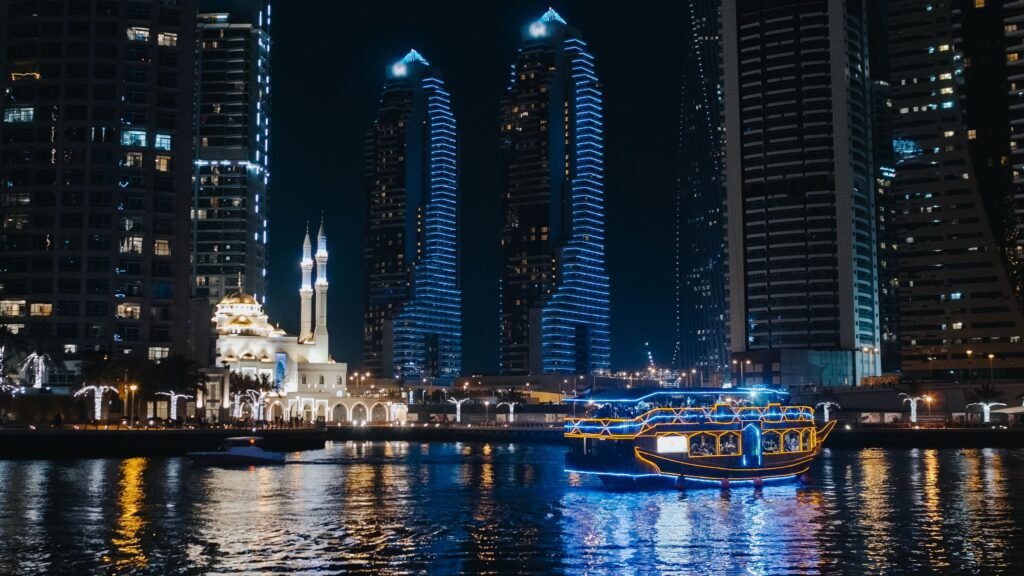
The choice of Riyadh for an anniversary that belongs to a Beirut house suggests how important the Gulf, as a market and a home for clients, has become to it.
Seen together, those projects show a house that has become a lifestyle brand as well as a fashion label. A gown can be worn a few times; a residence carries the brand’s name for years. The H&M announcement fits the same direction, in which the Elie Saab look is offered at several price levels and in several parts of daily life.
His current title is chairman and chief creative officer, according to The National, which means that the founder is still the person who decides what the house makes.
The H&M collection
H&M’s earlier designer partners include Karl Lagerfeld, Versace, Balmain, Moschino, Mugler and Glenn Martens, a list that shows the company’s habit of pairing its mass-market reach with names that have a strong identity. Elie Saab joins it as its latest.
The collection covers womenswear, menswear, accessories and shoes. According to The National and FashionUnited, it includes embellished gowns, shimmering separates, sharply cut tailoring, fine lace, gradient sequins, known as degradé, and the house monograms. FashionUnited reports that this is the first time Elie Saab has designed menswear, as the house had previously made womenswear only.
Ann-Sofie Johansson, H&M’s creative adviser and head of womenswear design, described it as a landmark collaboration, and said customers can expect a magical, ornate and very glamorous collection. Saab himself said that the process had been truly collaborative and inspiring.
For shoppers in the Gulf the practical details are straightforward. The National lists the UAE, Saudi Arabia, Kuwait, Bahrain, Qatar and Egypt as the regional markets with selected stores, and the collection will also be sold online, which matters for readers who do not live near one of those stores. The stores and dates are clear. What the clothes will look like in the shops, and how closely they follow the couture codes, will only be known when they go on sale on 22 October. The announcement describes the pieces but does not give prices.
What the high street asks
Collaborations of this kind are a negotiation between two ideas of luxury. One is made by hand, in small numbers, for a client who will wear a dress once. The other is made in large numbers for people who want a piece of the same look at a price they can manage. The question the high street raises is whether a house built on hand embroidery can keep its spirit when the same silhouettes are made for everyone.
There are three things worth watching when the collection arrives: how the first menswear is cut, how the degradé sequins and fine lace are handled at a lower price, and how the monograms are used. Each will show how much of the house’s identity travels.
Elie Saab’s history offers some reassurance, because he has crossed such lines before. He moved from bridal to ready-to-wear in 1998, from the red carpet to fragrance in 2011, and from fashion to branded residences more recently, each time extending the name into a new field. The H&M collection is a new test of that approach, and a chance for a much wider audience, including many readers in the Gulf, to see how it translates.
For now, the story is still at its opening. A young man who made dresses for his sisters, and opened a workroom in Beirut at 18, is about to see his name in shop windows on two continents. The gowns on the red carpet are expected to carry on being made by hand in the usual way, since the H&M range is a separate collection, not a replacement for the couture line. What changes, from 22 October, is how many people will be able to try the look on for themselves.
Sources: The National, FashionUnited, Fashion Trust Arabia, Wikipedia