When people compare watches, they usually talk about movements, dials and brands. The case material gets less attention, but it shapes the experience of owning a watch more than almost anything else. It decides how heavy the watch feels, how it reacts to scratches, how warm or cool it is against the skin, and how it will look in twenty years.
The material of a watch is not only a matter of price. It decides how the watch will feel on the wrist every single day. Here is what you need to know about the main choices.
Stainless steel
Most watches are made of stainless steel, and for good reason. It is strong, resistant to corrosion, relatively easy to machine and polish, and affordable. The standard grade is known as 316L, the same family of steel used in surgical instruments.
Some makers use other alloys. Rolex, for instance, began using 904L steel in the 1980s, an alloy with more chromium, nickel and molybdenum that resists corrosion particularly well and takes a bright polish. Whatever the grade, steel scratches with daily wear, but scratches can be polished out during a service, and many owners come to like the soft patina of a well-worn steel watch.
Titanium
Titanium is about forty per cent lighter than steel, strong and highly resistant to corrosion, including salt water. It is also hypoallergenic, which matters to people who react to the nickel found in some steels. Citizen produced one of the first titanium watches in 1970, and the metal has since become common in sports and dive watches.
There are two main types. Grade 2 titanium is commercially pure, slightly softer and grey in tone. Grade 5 is an alloy with aluminium and vanadium, harder, and able to take a higher polish. Titanium feels noticeably warm and light on the wrist, which makes it pleasant in hot weather. Its weakness is that it scratches more easily than steel and can be harder to refinish, so many makers treat its surface with special hardening processes.
Ceramic
Watch ceramic is usually made from zirconium oxide, pressed into shape and fired at very high temperatures. The result is extremely hard, almost impossible to scratch in normal use, light, and able to hold its colour indefinitely. In the 1980s a few makers, IWC and Rado among them, were among the first to use it for cases and bracelets; today it is common for bezels as well.
Ceramic's one real drawback is brittleness. It will not scratch, but a sharp blow on a hard surface can crack or chip it, and a damaged ceramic part usually has to be replaced rather than repaired. For most people this is a fair trade for a watch that looks new for decades.
Gold
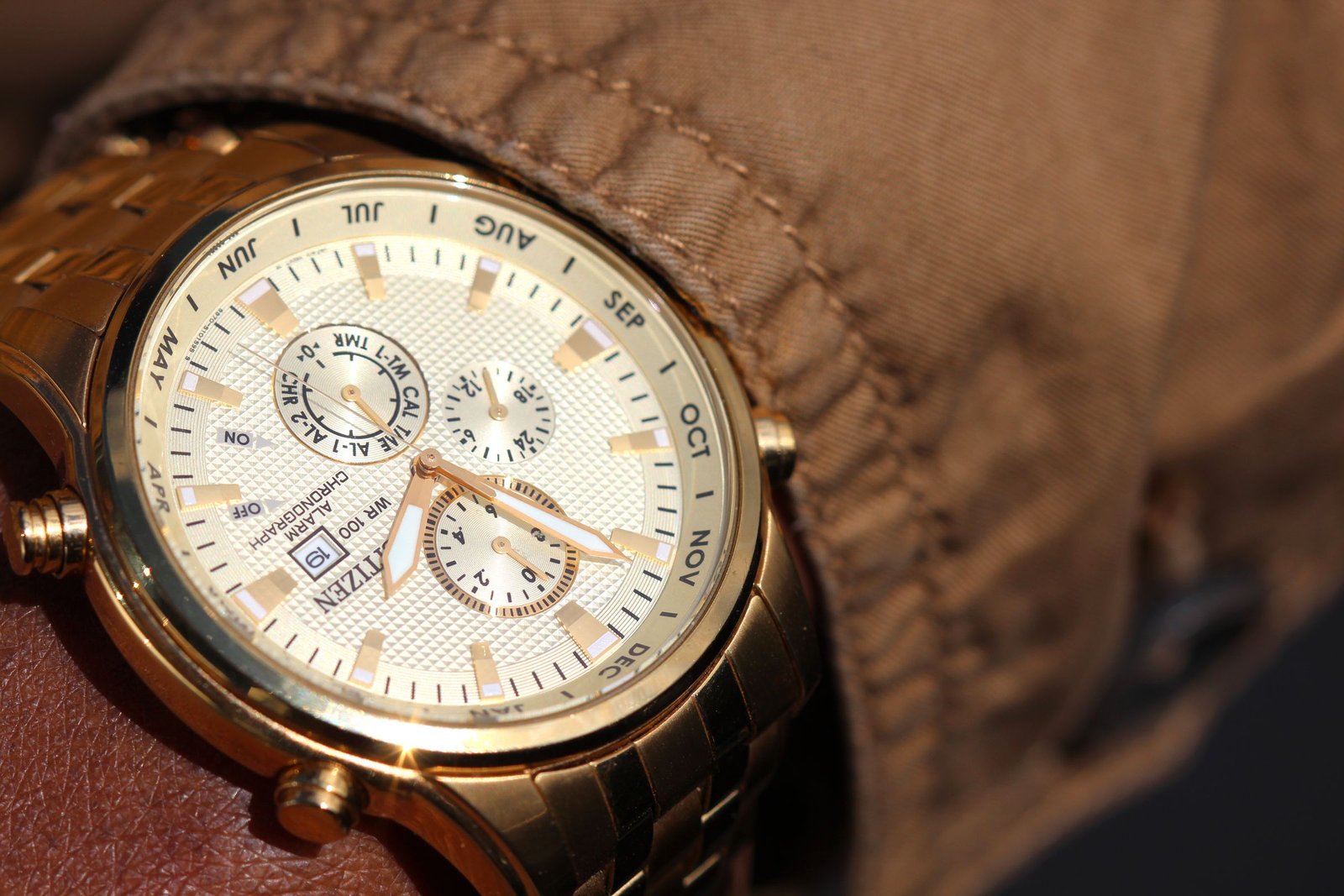
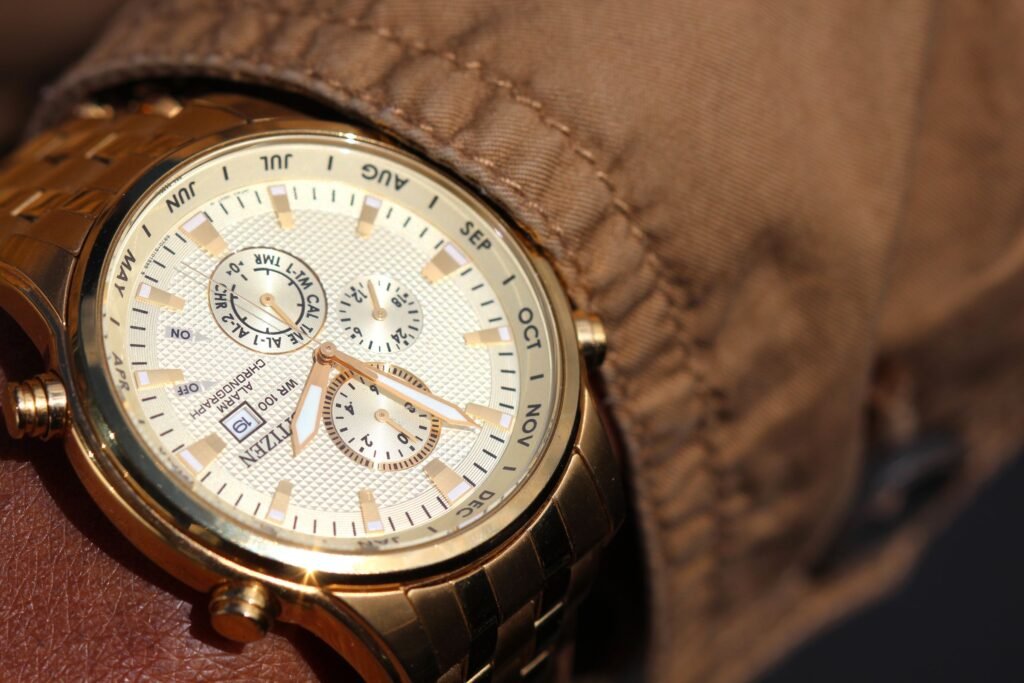
Gold used in watches is almost always 18 carat, meaning 75 per cent pure gold mixed with other metals for strength and colour. Yellow gold uses silver and copper; rose or red gold uses more copper; white gold uses metals such as palladium, and is often plated with rhodium for extra brightness.
Gold is heavy, warm in colour and soft. It scratches and dents more easily than steel, though it can be refinished. Rose gold could historically fade slightly over many years as its copper oxidised, and several houses have developed their own alloys designed to keep their colour. Gold also has a particular feel: a gold watch is noticeably heavier, and that weight is part of its appeal.
Platinum
Platinum is heavier and rarer than gold and is used in watches as an alloy of about 95 per cent purity. It is very dense, so a platinum watch feels substantial in the hand, and it has a cool, white lustre that looks a little like steel from a distance. That discretion is part of its appeal: platinum is a luxury that does not announce itself. It is also harder to work than gold, which adds to its cost.
Bronze
Bronze has become popular in recent years, especially for dive and military-inspired watches. Its appeal is its patina: over time, the surface darkens and develops a unique tone depending on the wearer's skin, climate and habits. Some people love this evolution; others find it unpredictable. Most bronze watches use a steel or titanium case back, because bronze can mark the skin.
In the humidity of the Gulf coast, bronze will develop its patina relatively quickly. It can be cleaned back to its original colour if you change your mind.
And the crystal
Almost every good modern watch uses a sapphire crystal: not the gemstone, but synthetic corundum grown in a laboratory. It is extremely hard, second only to diamond among common materials, so it resists scratches superbly. Its only weakness, like ceramic, is that a sharp impact can shatter it. Vintage watches often use acrylic crystals, which scratch easily but can be polished smooth again.
Choosing for your life
There is no best material, only the one that suits how you live. For a single watch worn every day, steel or titanium is hard to beat. For a watch that should look new for decades, ceramic is excellent. For the pleasure of weight and warmth, gold is unmatched, and platinum is gold's quieter, heavier cousin. And if you like the idea of a watch that changes with you, bronze will tell your story on its surface.
In a hot climate, consider comfort as well as looks. Lighter materials like titanium and ceramic are noticeably more pleasant in summer, and a heavy gold bracelet can feel warm in the afternoon sun. The best watch is the one you will want to wear in August as much as in January.