Amman Design Week opens today, Friday 2 October, for its first edition in seven years. The festival, founded by Queen Rania in 2016, runs until 17 October across the Jordanian capital's oldest hill districts and, for the first time, in Aqaba on the Red Sea. Its main exhibitions and programmes are free and open to the public.
This is the fourth edition, and its theme is "Accumulations", تراكمات in Arabic. The organisers describe it as an exploration of how design builds up in layers over time, through materials, processes, ideas, memories and shared knowledge.
On 30 September, ahead of the opening, Queen Rania toured the Hangar Exhibition with Princess Iman and the festival's co-directors, Sarah Hejazin and Bisher Tabaa. The scale of what follows is considerable. Yanko Design counts more than 220 designers, 59 participating spaces and 204 events, while Dezeen's events guide lists 50 venues. The programme spans architecture, materiality, textile and product design, presented through installations, talks, panels, workshops, tours, screenings and performances.
The idea behind "Accumulations"
The 2026 edition has two curators. Faysal Tabbarah, the exhibitions curator, was born in Aleppo, teaches at the American University of Sharjah's College of Architecture, Art and Design and at Carleton University, and co-founded the practice Architecture + Other Things in Sharjah. Khaled Al-Bashir, the programmes curator, is arts and culture director at Darat al Funun, the Khalid Shoman Foundation. The festival's visual identity is by Mina Maurice.
The curatorial team opens with a line by the Abbasid poet Ibn al-Mu'tazz, which Yanko Design translates as "Do not dismiss the small; mountains are made of pebbles." It is a fair summary of the theme: small acts of making, repeated and passed on, add up to something large.
Start at the Hangar
The festival's centre is the Ras El Ain Hangar, a restored former electricity hangar from the 1930s. It hosted the first Hangar Exhibition in 2016, whose curator was Sahel Al Hiyari, and the shows that followed: Ahmad Humeid's in 2017 and Noura Al Sayeh-Holtrop's "Possibilities" in 2019.
This year's exhibition is arranged in three sections, which the curators call registers: Reserves and Repositories; Systems and Structures; and Practices and Processes. Each project is shown as a diptych, paired with what the curators call a "trace": an artefact, an archival document or an oral history. A piece of design and the evidence of where it came from sit side by side.
The exhibitors come from across the region and beyond: Jordan, Palestine, Syria, Lebanon, Iraq, Saudi Arabia, Kuwait, Bahrain, Qatar, Egypt, India and Armenia.
Walk the old hills
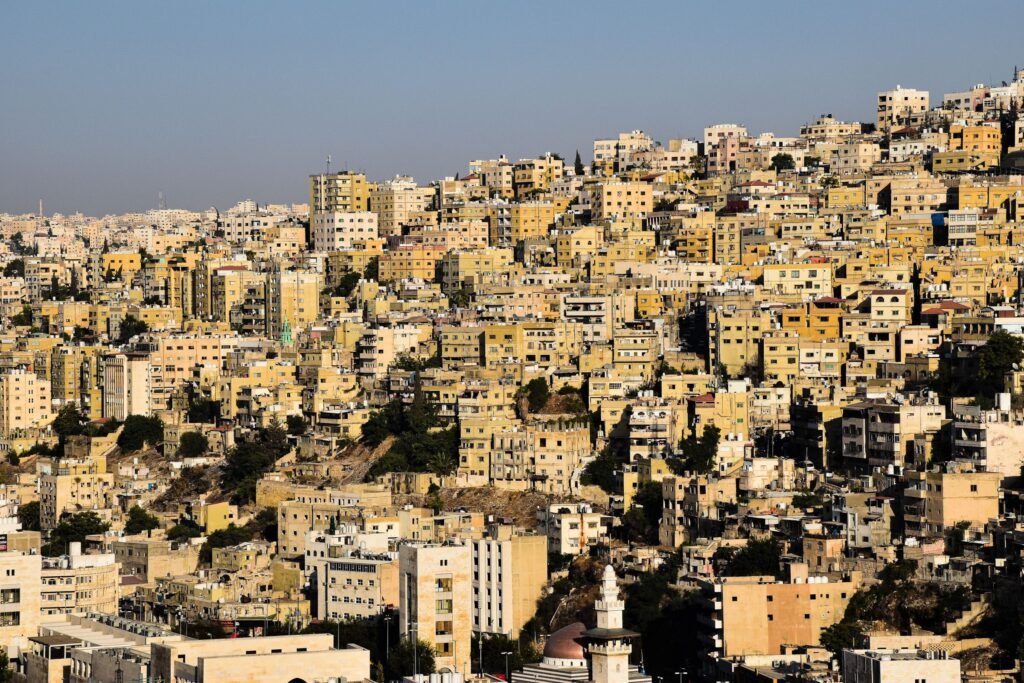
Beyond the Hangar, the programme moves through the city. The districts taking part include Ras El Ain, Jabal Al Lweibdeh, Jabal Amman and Iraq al Amir.
Jabal Al Lweibdeh and Jabal Amman are among Amman's oldest residential hills, known for their early 20th-century limestone houses and the public stairways that connect one street to the next. They are best explored on foot. Jabal Al Lweibdeh is also home to Darat al Funun, the long-established arts institution where Al-Bashir works, which makes it a natural second stop after the Hangar.
A festival about accumulation has found a fitting home in a city built in layers up its hills.
Aqaba joins for the first time
This year, Amman Design Week reaches beyond the capital. Its Aqaba programme, on Jordan's Red Sea coast, was developed with the WUJUD Art Foundation. For visitors from the Gulf, it opens the possibility of pairing a few days of design in Amman with time by the sea in the south.
A bridge to Saudi Arabia
The festival has a clear Gulf thread. Designers from Saudi Arabia, Kuwait, Bahrain and Qatar are among the exhibitors, and the exhibitions curator is based in Sharjah. A residency, Ithra Design Week x ADW, pairs designers from Jordan and Saudi Arabia, linking the festival with Ithra, the King Abdulaziz Center for World Culture in Dhahran.
What stays behind
Not everything closes on 17 October. Four permanent works will remain in the city after the festival, including a shade structure and a basketball court in Ras El Ain Park. They give the 2026 edition a life beyond its 16 days.
Plan your visit
The organisers projected 90,000 visitors over the 16 days, of whom 5,000 to 10,000 would come from abroad. These are expectations rather than attendance figures, but they give a sense of the scale the organisers are planning for.
- Dates: 2 to 17 October 2026
- Entry: the main exhibitions and programmes are free
- Start: the Hangar Exhibition at the Ras El Ain Hangar
- Districts: Ras El Ain, Jabal Al Lweibdeh, Jabal Amman, Iraq al Amir and, in the south, Aqaba
- Programme and venues: ammandesignweek.com
Amman is a short flight from every Gulf capital, which makes the festival an easy autumn weekend. A sensible plan is to give the first day to the Hangar and the second to the hill districts on foot, and to check the online programme before travelling for the dates of talks, tours and workshops, since many of them take place on set days within the 16-day run.
Sources: Amman Design Week, Amman Design Week, Amman Design Week, Dezeen, Yanko Design, Jang