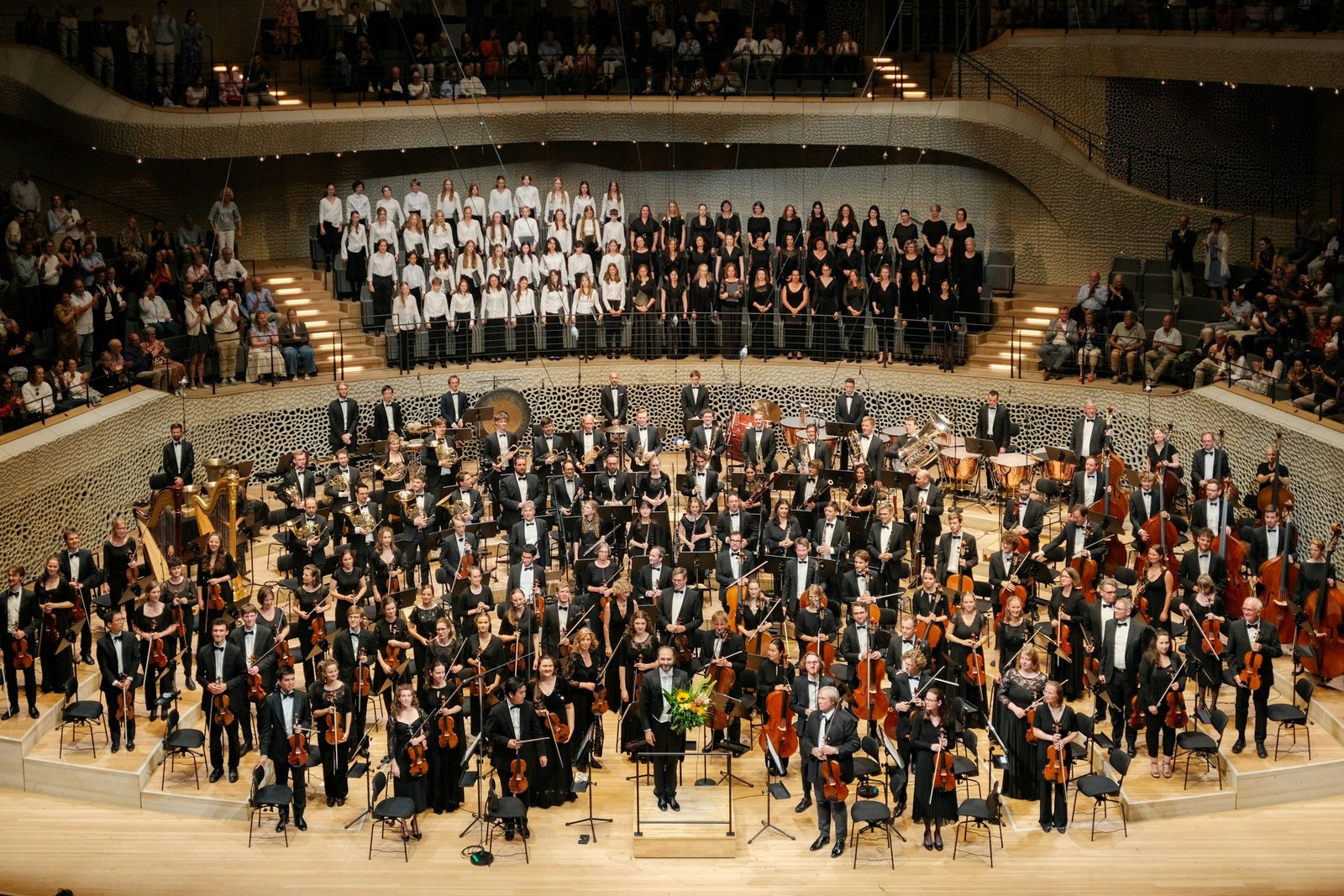
The conductor Herbert Blomstedt has been named the music laureate of the 37th Praemium Imperiale. The Japan Art Association announced the 2026 laureates on 8 September, simultaneously in Paris, Rome, Berlin, New York, London and Tokyo. Blomstedt is 99. He will turn 100 in July 2027, and he has, by the account of the prize itself, continued to conduct leading orchestras into his tenth decade, often from memory.
The prize carries ¥15 million. The ceremony is scheduled for 28 October 2026 at the Meiji Kinenkan in Tokyo, where Prince Hitachi is due to present the medals. The other 2026 laureates are Jenny Holzer in painting, Andy Goldsworthy in sculpture, Daniel Libeskind in architecture and Cate Blanchett in theatre and film.
According to the Japan Art Association’s award statement, as reported by The Violin Channel, Blomstedt conducts internationally leading orchestras with undiminished energy even in his tenth decade. The statement adds that his concerts show a rare ability to illuminate familiar scores with new freshness and wisdom.
From Springfield to Stockholm
Blomstedt was born on 11 July 1927 in Springfield, Massachusetts, to Swedish parents. He grew up mainly in Sweden and Finland, and the Praemium lists his nationality as Swedish.
He studied in Stockholm and Uppsala, with further training in New York, Basel and at Tanglewood, the summer music centre in Massachusetts, where he studied with Leonard Bernstein in 1953. He also worked with Igor Markevitch, Jean Morel and Paul Sacher. His conducting debut came in 1954 with the Stockholm Philharmonic.
The orchestras
The list of posts reads like a map of European and American orchestral life. Blomstedt was chief conductor of the Oslo Philharmonic and of the Danish and Swedish radio orchestras. He then led the Staatskapelle Dresden from 1975 to 1985 and was music director of the San Francisco Symphony from 1985 to 1995. He later became chief conductor of the NDR Symphony Orchestra in Hamburg, and from 1998 to 2005 he was Gewandhauskapellmeister in Leipzig, the title given to the director of the Gewandhaus Orchestra.
The Praemium credits him with raising the San Francisco Symphony to the ranks of America’s foremost orchestras, with international tours and an acclaimed recording series. He is today Conductor Laureate of that orchestra. On 15 May 2026 he conducted Mahler’s Ninth Symphony with the San Francisco Symphony at Davies Symphony Hall, and in September 2025 he appeared at the Gewandhaus.
The dates are worth setting side by side. He spent ten years in Dresden, ten years in San Francisco and seven in Leipzig, with the Hamburg post and the Scandinavian orchestras around them. These are long stretches in any conductor’s life, and they explain how a single musician could shape the sound of several orchestras over time.
Mahler’s Ninth, which he conducted in San Francisco this May, is among the longest and most demanding symphonies in the repertoire, and it ends with a long, slow Adagio. To lead it at 98, as he did on that date, is the kind of detail that explains why the prize committee spoke of undiminished energy.
A repertoire of discipline
Blomstedt is known as a champion of Scandinavian composers. The Praemium names Carl Nielsen, Jean Sibelius and Franz Berwald, a trio that he brought to audiences far beyond the Nordic countries. He is also known for his Beethoven, Bruckner, Schubert, Brahms, Mendelssohn and Strauss.
The two groups tell a consistent story. Nielsen and Sibelius ask for clarity of line and a firm sense of structure over long spans, while Bruckner and Beethoven demand patience and architecture. A conductor who has spent seven decades with these scores is working from an accumulated understanding rather than from habit, and conducting from memory is the visible sign of that. It means that the score has been absorbed so thoroughly that the conductor can face the players rather than the page.
Continuity as a career
Blomstedt’s record covers an unusual span. He made his debut in 1954, and the Praemium honours him more than seven decades later. In between he held posts in Scandinavia, Dresden, California, Hamburg and Leipzig, several of them for a decade or more.
That is part of why the prize matters. The Praemium Imperiale has been given since 1989 and is awarded across the arts. Laureates are chosen from nominations by six international advisers to the Japan Art Association. For Blomstedt, it recognises not a single recording or season but a body of work built over a lifetime.
What comes next
The ceremony in Tokyo on 28 October is the next date to watch. After that, the calendar points to his 100th birthday in July 2027.
For readers in the Gulf, where houses such as Dubai Opera and the Royal Opera House Muscat bring classical music to a wide public, Blomstedt’s story offers a model of what a long musical life can be: built on discipline, loyalty to a few great scores and the patience to keep returning to them. The connection is one of example rather than of place, and it is worth the attention of anyone who cares about how music is learned and passed on.
Sources: Praemium Imperiale, Praemium Imperiale, The Violin Channel