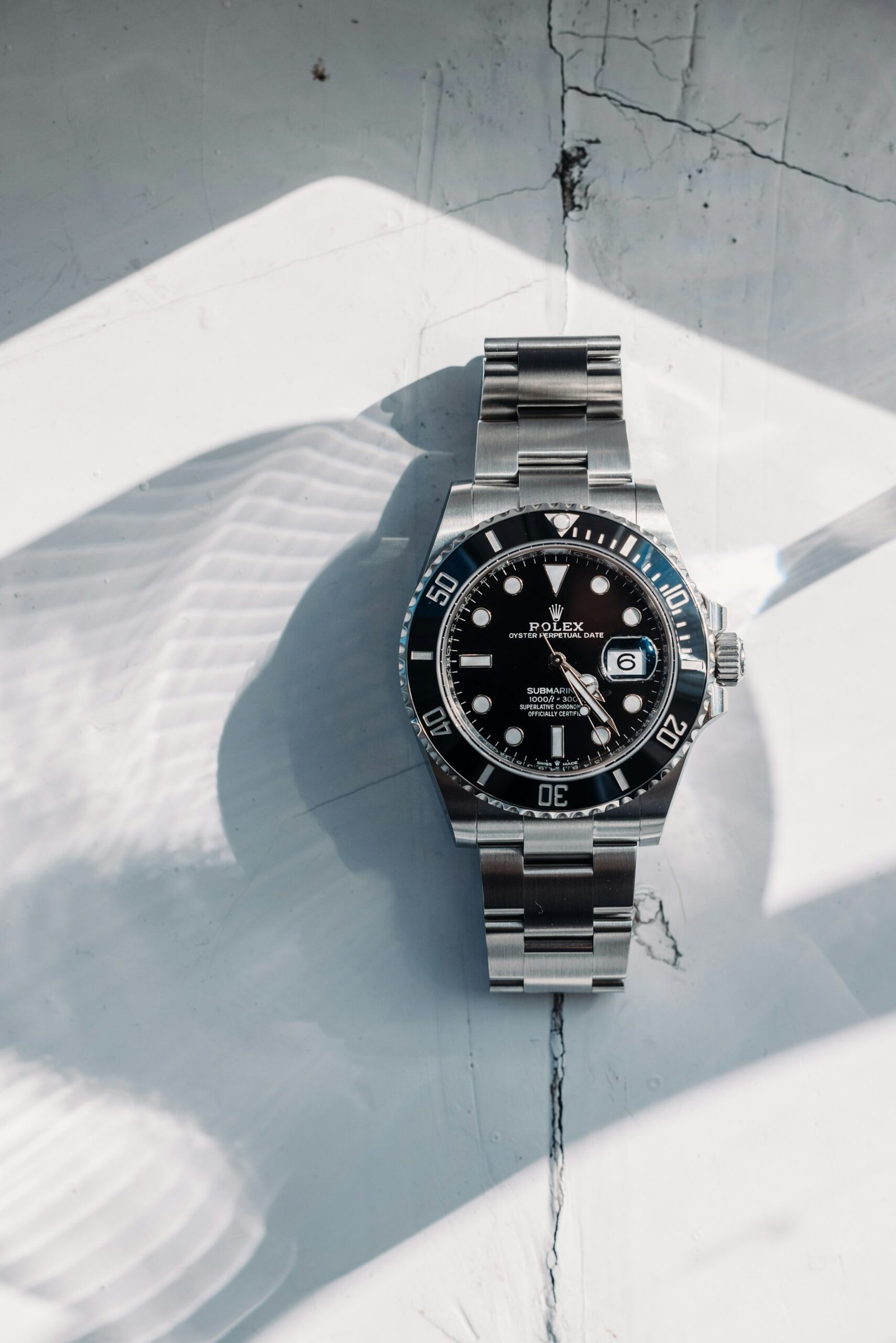
There are watches that people recognise from across a room, and then there is the Submariner. A black dial, fat luminous markers, a rotating bezel with a small triangle at twelve o'clock: the shape is so familiar that it has become shorthand for the idea of a luxury watch itself. It is copied, borrowed and paid tribute to more than any other design in the business.
Yet the Submariner was never designed to be beautiful. It was designed to be read underwater, by a person whose life depended on knowing how long they had been down. That it turned out to be beautiful as well is the quiet lesson of its seven decades.
A practical question
In the early 1950s, recreational scuba diving was new. The aqualung had only been in use for a decade, and the people who used it needed a watch that could survive pressure, keep out water and tell them, at a glance, how much time had passed since they went under.
Rolex had a head start. Its Oyster case, patented in 1926, was one of the first truly waterproof watch cases, sealed by a screw-down back and crown. What the company built in 1953 was an Oyster made for depth: a sturdier case, a crown that screwed down tightly against gaskets, and a rotating bezel marked in minutes. Before a dive, the diver turned the bezel so that its zero marker lined up with the minute hand. Thereafter the elapsed time could be read straight off the bezel, without any arithmetic.
The first references, 6204 and 6205, were rated to 100 metres. The watch was shown to the public at the Basel fair in 1954, and within a year a version rated to 200 metres followed. The idea was simple enough to explain in a sentence, and that, more than any technical feat, is why it lasted.
The tool years
For its first two decades the Submariner was exactly what it claimed to be: equipment. It was issued to military divers in several countries, worn by commercial divers and bought by people who actually needed it. Its dial was matte, its hands were large, and its markers were painted with luminous material so that they could be read in the gloom below twenty metres.
The reference that most people picture when they imagine a vintage Submariner is the 5513. It was made from 1962 until around 1990, almost unchanged for nearly thirty years. It added protective shoulders around the crown, so that a knock against a rock or a boat could not wrench it out, and it carried no date, which kept the dial clean and the case simple.
The Submariner also found its way into film early. In 1962, Sean Connery wore a reference 6538 as James Bond in Dr. No, and the watch on the wrist of the most famous spy in cinema did more for its reputation than any advertisement. It suggested that this was a watch for people who did things, not for people who only owned things.
The Submariner was never designed to be beautiful. It was designed to be read, and that turned out to be the same thing.

The date, the ceramic and the slow evolution
The most remarkable thing about the Submariner's history is how little happens in it. Where other watches were redesigned for each new decade, the Submariner changed by millimetres.
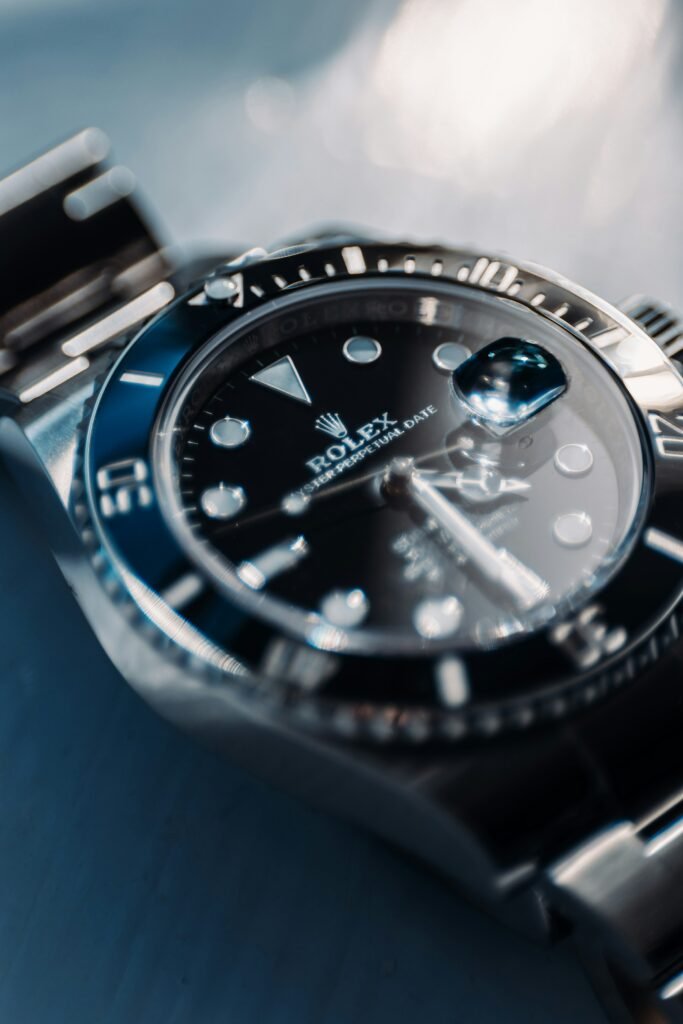
The first big addition came at the end of the 1960s, when reference 1680 became the first Submariner with a date. A magnifying lens, which Rolex calls the Cyclops, was placed over the date window so the numeral could be read easily. Purists grumbled that it spoiled the symmetry of the dial. Buyers disagreed, and the Submariner Date has been made ever since alongside the no-date version.
In the 1980s Rolex began using 904L steel, a highly corrosion-resistant alloy more often found in chemical plants than in jewellery. It is harder to machine than ordinary watch steel, but it polishes to a particular brightness and resists salt water well, which suits a watch that spends time in the sea.
The 2000s brought colour and ceramic. In 2003, to mark fifty years, Rolex produced a Submariner Date with a green bezel. It was meant as a celebration, and it became one of the most sought-after modern models. From 2008 the aluminium bezel inserts that faded over decades gave way to Cerachrom, Rolex's ceramic, which is almost impossible to scratch and keeps its colour indefinitely.
The most recent change came in 2020. The case grew from 40 to 41 millimetres, the lugs were made slimmer so the watch looks no larger on the wrist, and new movements, calibres 3230 and 3235, were fitted, with a power reserve of about seventy hours. Placed beside a model from the 1960s, it is plainly the same watch. That is the point.
The deep relatives
The Submariner sits at the centre of a small family of tool watches, and its relatives went far deeper than it ever needed to.
On 23 January 1960, the bathyscaphe Trieste descended to the bottom of the Challenger Deep in the Mariana Trench, almost eleven kilometres below the surface. Strapped to its hull was an experimental Rolex called the Deep Sea Special. It came back up working. The record was not set by a person wearing a watch, but by a machine carrying one, and it proved that a well-built mechanical case could take pressure beyond anything a human body could.
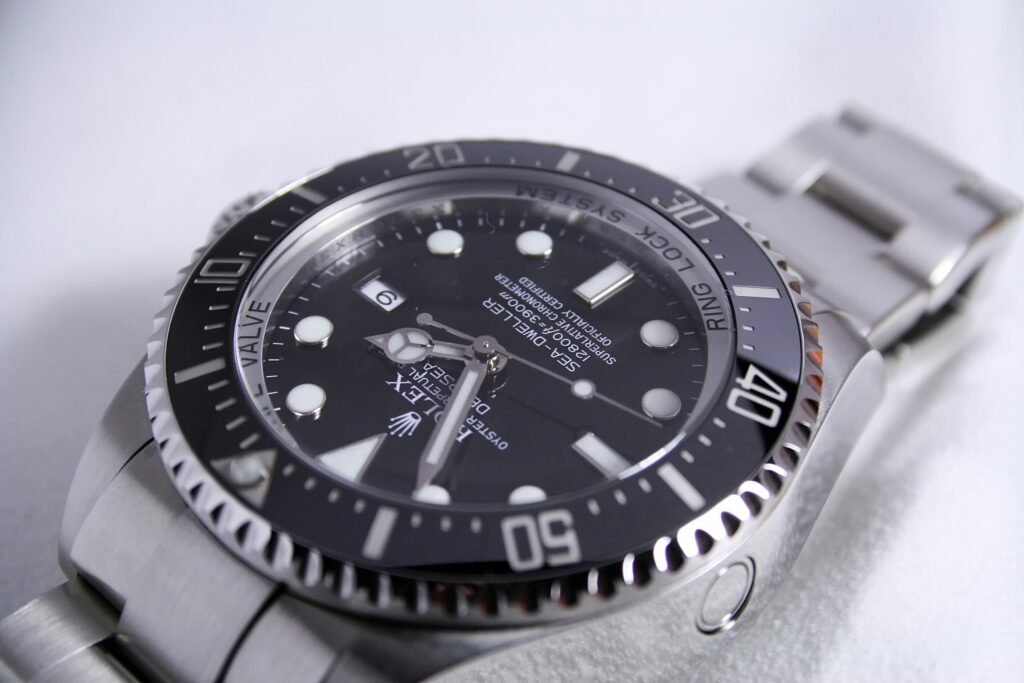
A practical descendant followed for commercial divers. Saturation divers, who live for days in pressurised chambers breathing a mixture containing helium, had a problem with ordinary watches: helium atoms worked their way inside, and during decompression the gas could not get out fast enough, sometimes pushing the crystal off the case. Rolex's answer was the Sea-Dweller, introduced at the start of the 1970s with a small helium escape valve in the side of the case. The modern Deepsea, launched in 2008, is rated to 3,900 metres.
None of these figures matter to someone wearing a Submariner on a boat in the Red Sea. But they explain why the watch is trusted: it is the everyday member of a family built for extremes.
Why it lasted
It is easy to say that the Submariner lasted because of marketing, and marketing certainly helped. But many well-advertised watches have come and gone. The deeper reason is that its design was settled early and correctly.
Every element answers a question. The bezel times a dive. The markers are shaped differently, circles, batons and a triangle, so that the hour can be read even if the watch is upside down or the light is poor. The case is sized to sit flat on the wrist and fit under a cuff. Nothing on the dial is decoration; even the colours are there for contrast. When the form of a thing follows from its use so closely, there is little reason to change it, and every change becomes a refinement rather than a reinvention.
There is also the matter of trust. A Submariner bought in 1975 can still be serviced today. Parts are available, the movement is understood by watchmakers everywhere, and the watch will keep working for another fifty years if it is looked after. In an age of disposable things, that durability has become a luxury in itself.
Collectors across the Gulf know this well. A steel Submariner is often a first serious watch, bought for a graduation or a first salary, worn daily and eventually handed down. It is rarely the most expensive watch in a collection, but it is often the one that gets worn most.
Choosing one today
For anyone thinking of buying a Submariner, the first decision is the simplest: date or no date. The no-date model, often called the "no-date" by collectors, has the cleaner dial and the closest link to the original. The Submariner Date is the more practical everyday watch, and the Cyclops lens has become so much a part of the Rolex look that many people would miss it.
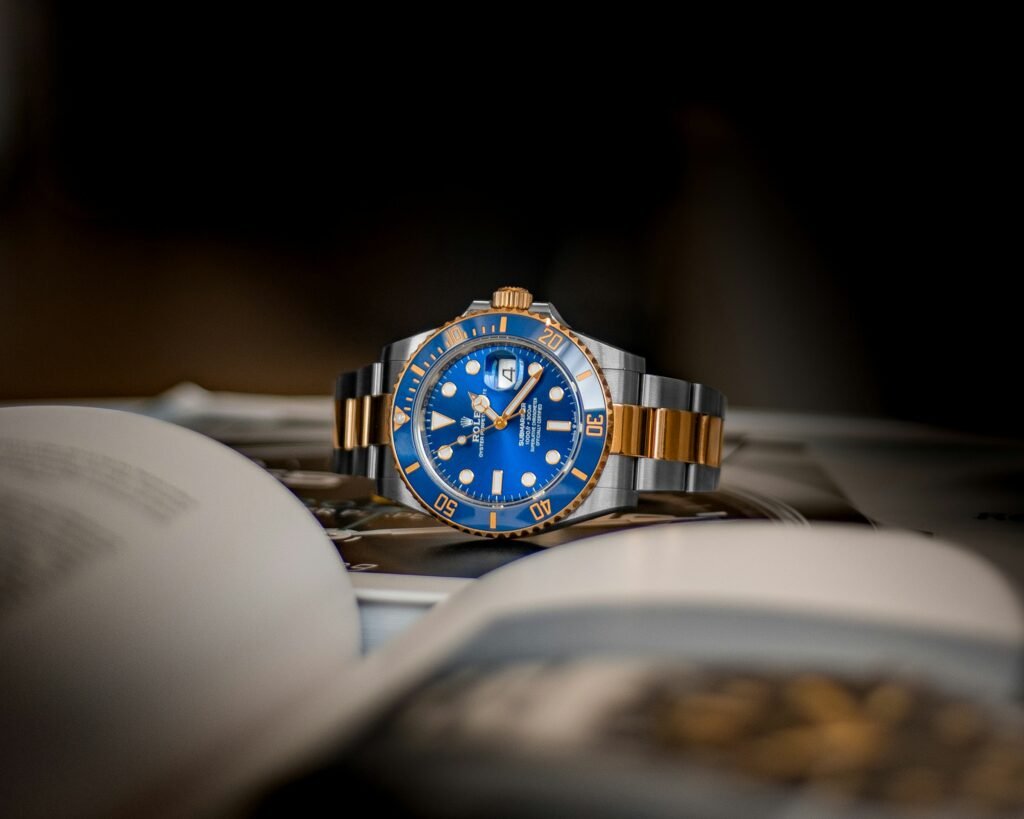
The second decision is metal. Steel is the classic choice and the one most associated with the watch's history. Steel and yellow gold, which Rolex calls Rolesor, arrived in the 1980s and has a following of its own, particularly in warmer climates where gold reads well against tanned skin. Full gold and white gold versions exist too, heavier and more formal, with blue or black dials.
Then there is the question of new or vintage. A modern Submariner is more robust, more accurate and easier to service, with a ceramic bezel that will look the same in twenty years. A vintage reference, a 5513 or an early 1680, has a softer charm: faded bezels, aged luminous paint and the small irregularities of a watch made with older tools. Vintage buying requires knowledge and a trusted dealer, because originality matters enormously to value, and replaced parts are common.
Whatever the choice, the Submariner rewards being worn. It is not a watch to keep in a safe. Its steel scratches, its bracelet gains a little play over the years, and each mark becomes part of its record. That, more than any certificate, is what makes one truly yours.
Seven decades on
The Submariner is now worn far more often in offices and restaurants than under water. It does not matter. The qualities that made it a good tool, clarity, durability and restraint, are exactly the qualities people look for in anything they intend to keep.
Past seventy, it remains a watch you can explain to a child: turn the ring, and it tells you how long. Few luxury objects can say as much, and fewer still have said it so consistently for so long.