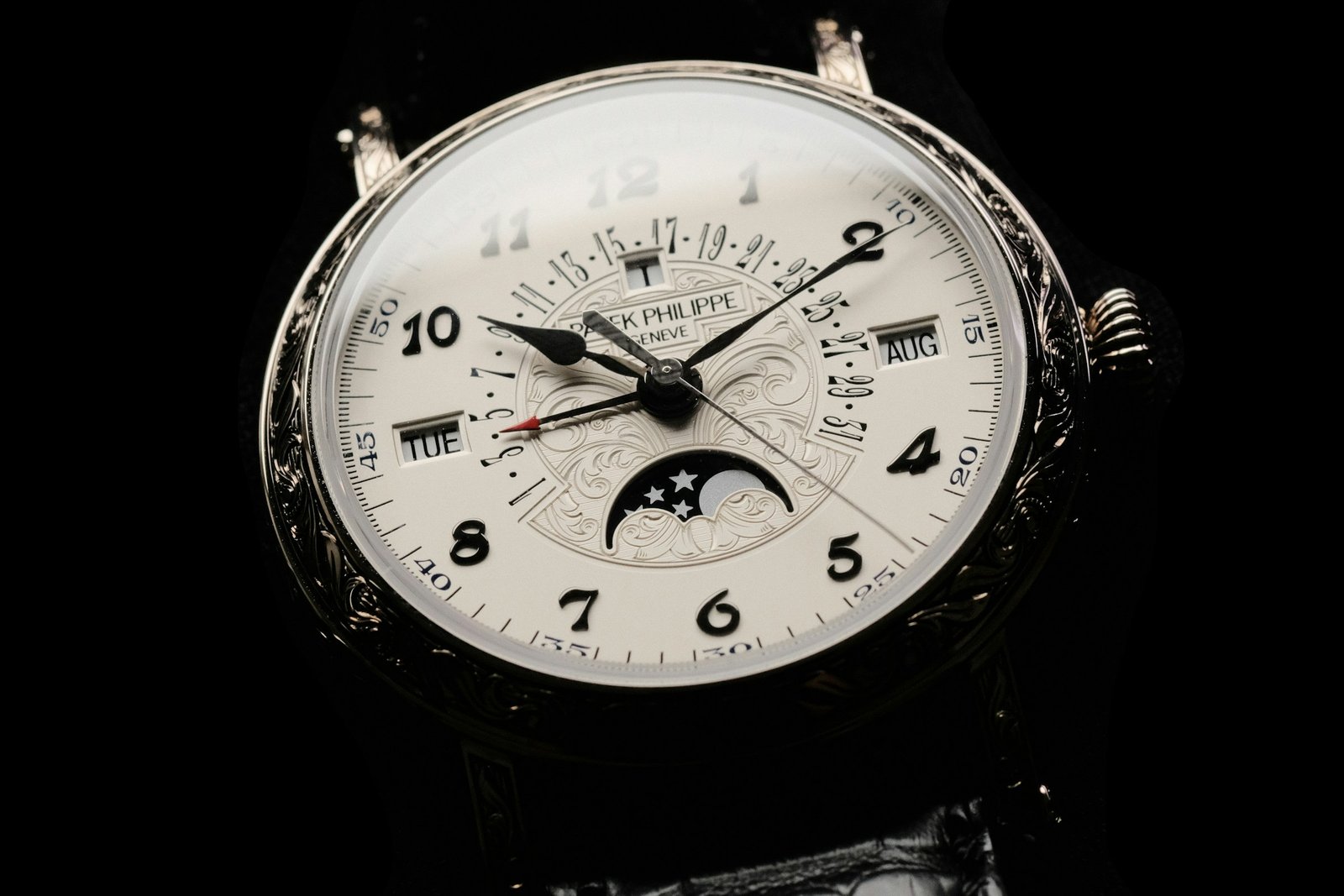
Watch people use the word complication constantly, and it can sound like a private language. It is simpler than it seems. A complication is anything a watch does beyond telling the hours, minutes and seconds. A date window is a complication. So is a stopwatch, a second time zone or a small disc showing the phase of the moon.
Some complications are genuinely useful every day. Some are feats of engineering that you will admire far more often than you use. This guide goes through the main ones, roughly from the simplest to the most demanding, with an honest note on what each is like to live with.
The date and the day
The most common complication is the date, shown in a small window, usually at three o'clock. A day-date adds the day of the week. Both are driven by a wheel that advances once every twenty-four hours.
The catch is that a simple date mechanism does not know how long each month is. At the end of any month with fewer than thirty-one days, you have to move it forward by hand. It is a small ritual, and most people do not mind.
One practical warning: on many mechanical watches, the date should not be changed by hand between about nine in the evening and three in the morning, when the mechanism is already engaging to make the change. Forcing it then can damage the teeth.
Two time zones
A GMT watch adds a second hour hand that goes round once every twenty-four hours, read against a 24-hour scale on the bezel or dial. Set it to home time and you can read two zones at a glance. A world-time watch goes further, showing the hour in all twenty-four zones at once using a rotating ring of city names.
For anyone who travels or works across time zones, from Riyadh to London or Dubai to Singapore, this is probably the most useful complication there is.
The chronograph
A chronograph is a stopwatch built into a watch. One pusher starts and stops it, another resets it to zero, and small sub-dials count the elapsed minutes and hours. Many have a tachymeter scale around the edge, which converts a measured time into a speed over a fixed distance.
Chronographs are mechanically complex, because the stopwatch has to engage and disengage from a running movement without disturbing it. Variations include the flyback, which resets and restarts with a single press, and the split-seconds or rattrapante, which has two seconds hands so that two events can be timed at once.
They are also enormously satisfying to use, even if the most demanding thing you time is a soft-boiled egg.
The moon phase
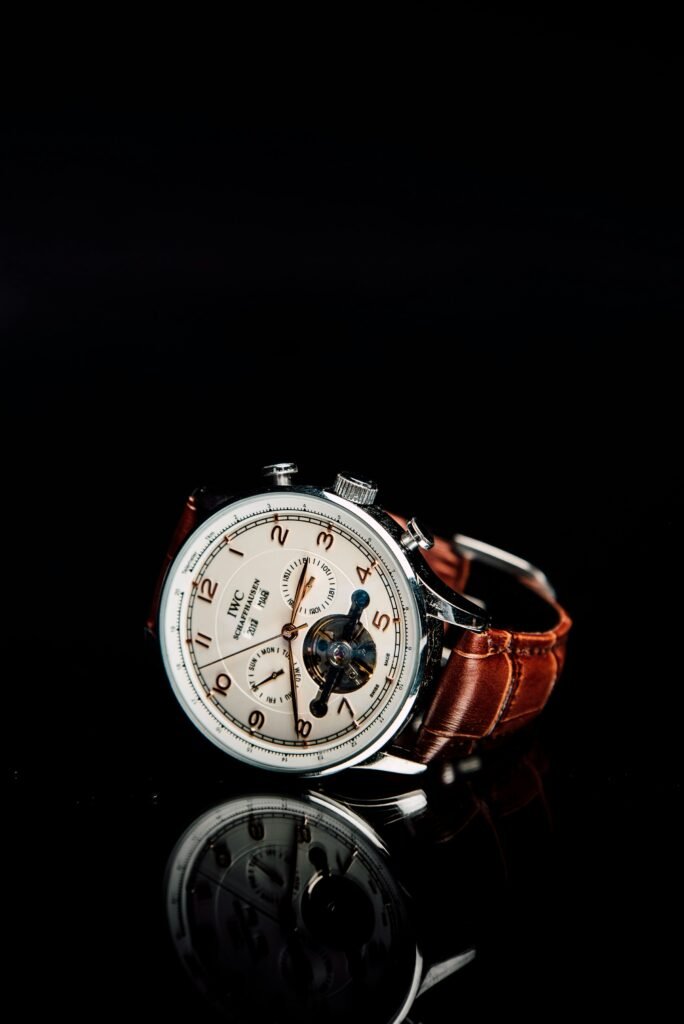
A moon phase display shows the shape of the moon in the sky, using a disc painted with two moons that turns slowly behind a curved opening in the dial. The lunar month lasts about twenty-nine and a half days, and a common mechanism advances the disc once a day using a wheel with fifty-nine teeth, which covers two lunar months.
The result is accurate to within a day for about two and a half years. More refined versions stay correct for over a century. It is not an essential complication, but it is one of the most beautiful, and in a region where the months of the Hijri calendar begin with the new crescent, it carries a particular meaning.
Annual and perpetual calendars
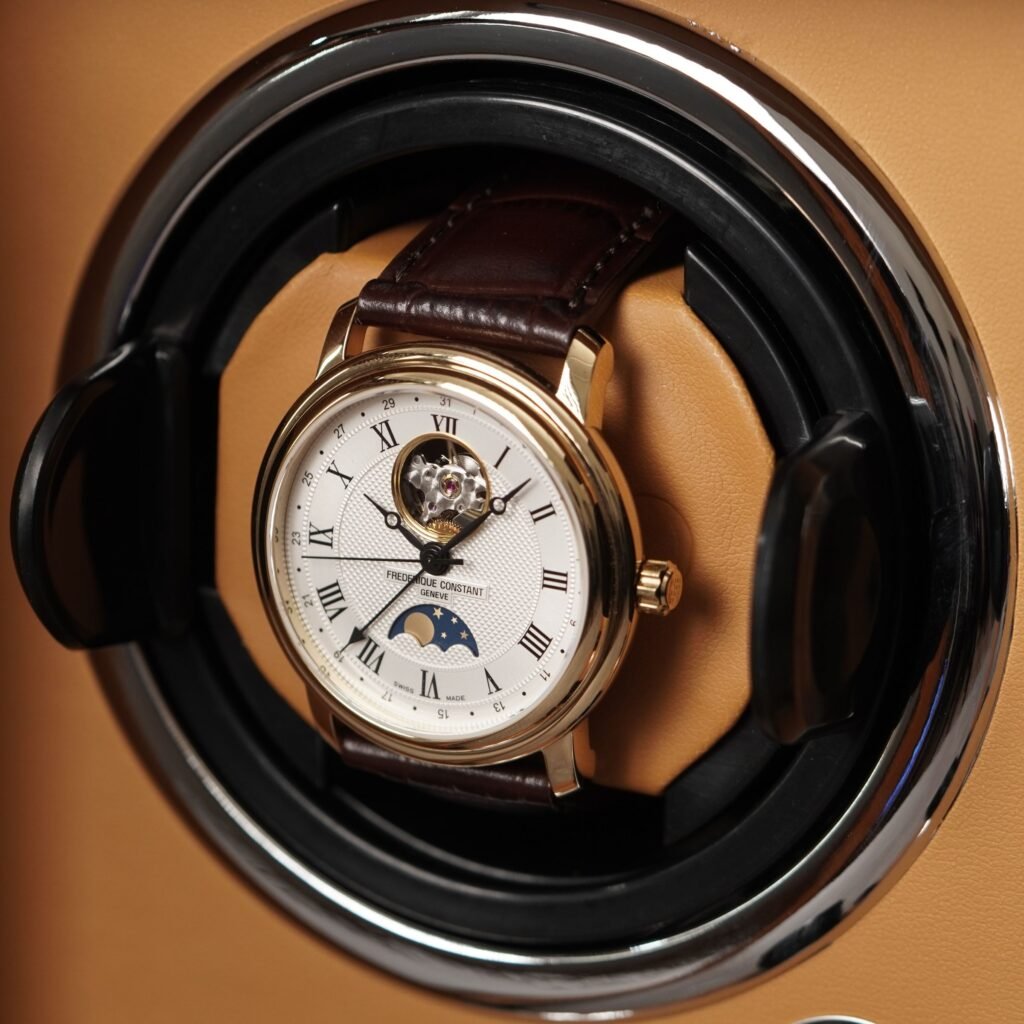
An annual calendar knows the difference between months of thirty and thirty-one days, and needs correcting only once a year, at the end of February. Patek Philippe introduced the idea in 1996, and it has become a practical favourite.
A perpetual calendar goes further. It knows the length of every month, including February in leap years, and will show the correct date without correction until the year 2100, which is not a leap year under the Gregorian rules. It does this with a small mechanical memory, often a wheel that turns once every four years.
Perpetual calendars are wonderful, but they reward being worn. If one stops, resetting it can take patience and should be done with care, ideally following the maker's instructions or with the help of a watchmaker.
Chiming watches
The most complicated watches are the ones that make sound. A minute repeater, at the press of a slide, strikes the time on tiny gongs: low notes for the hours, a pair of notes for each quarter, and high notes for the minutes since the last quarter. It was invented to tell the time in the dark, before electric light, and it remains one of the hardest things to make well, because the quality of the sound depends on the shape of the gongs, the hammers and even the case.
Grande and petite sonneries go further still, striking the hours and quarters automatically as they pass, like a church clock on the wrist.
The tourbillon
The tourbillon is less a function than a device. It mounts the escapement, the part that regulates the watch, in a small rotating cage, so that the errors caused by gravity in one position are averaged out as it turns. Abraham-Louis Breguet patented it in 1801 for pocket watches, which spent hours in the same vertical position. In a wristwatch, which moves constantly, its benefit is debated. Its beauty is not.
Which one to choose
If you want one complication for daily life, a date or a GMT will earn its place. A chronograph is the most enjoyable to use. A moon phase is the most poetic. Annual and perpetual calendars suit people who wear one watch most days and enjoy its quiet intelligence. Repeaters and tourbillons belong to a different category: they are the pinnacle of the craft, and they are bought for the admiration they inspire as much as for anything they do.
The best advice is the simplest. Choose the complication you will actually use, or the one you will never tire of looking at.