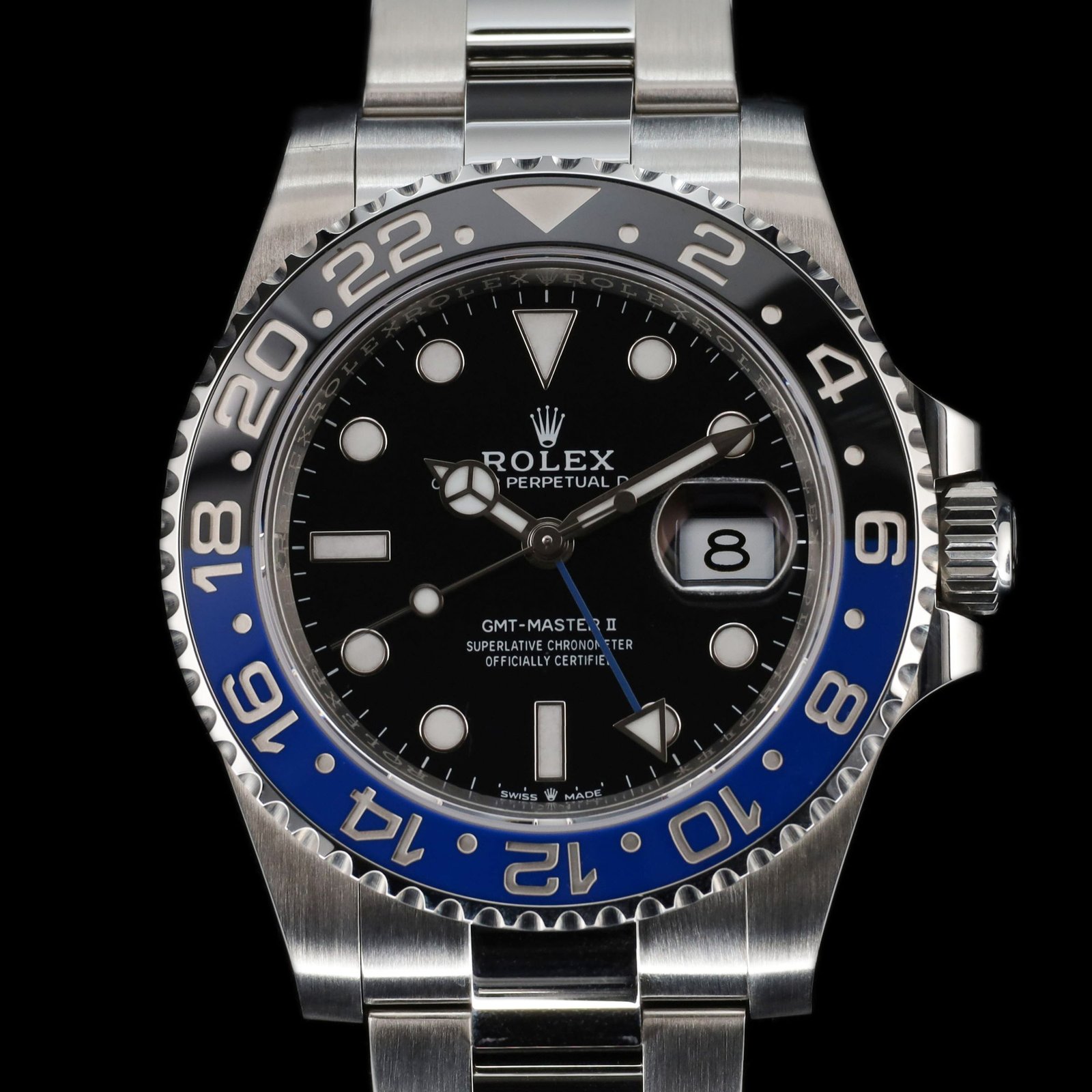
In the early 1950s, flying across oceans became routine for the first time. Jet aircraft and long-range propeller planes carried passengers from New York to Europe in a single night, and the crews who flew them faced a new problem. Their bodies, their schedules and their navigation all depended on time, but time itself kept changing beneath them.
Pilots needed to know two things at once: the local time where they were, and a fixed reference time that all aviation used. That reference was Greenwich Mean Time, the solar time at the Royal Observatory in Greenwich, London, adopted as the world's prime meridian in 1884. The watch that solved the problem took its name.
The airline watch
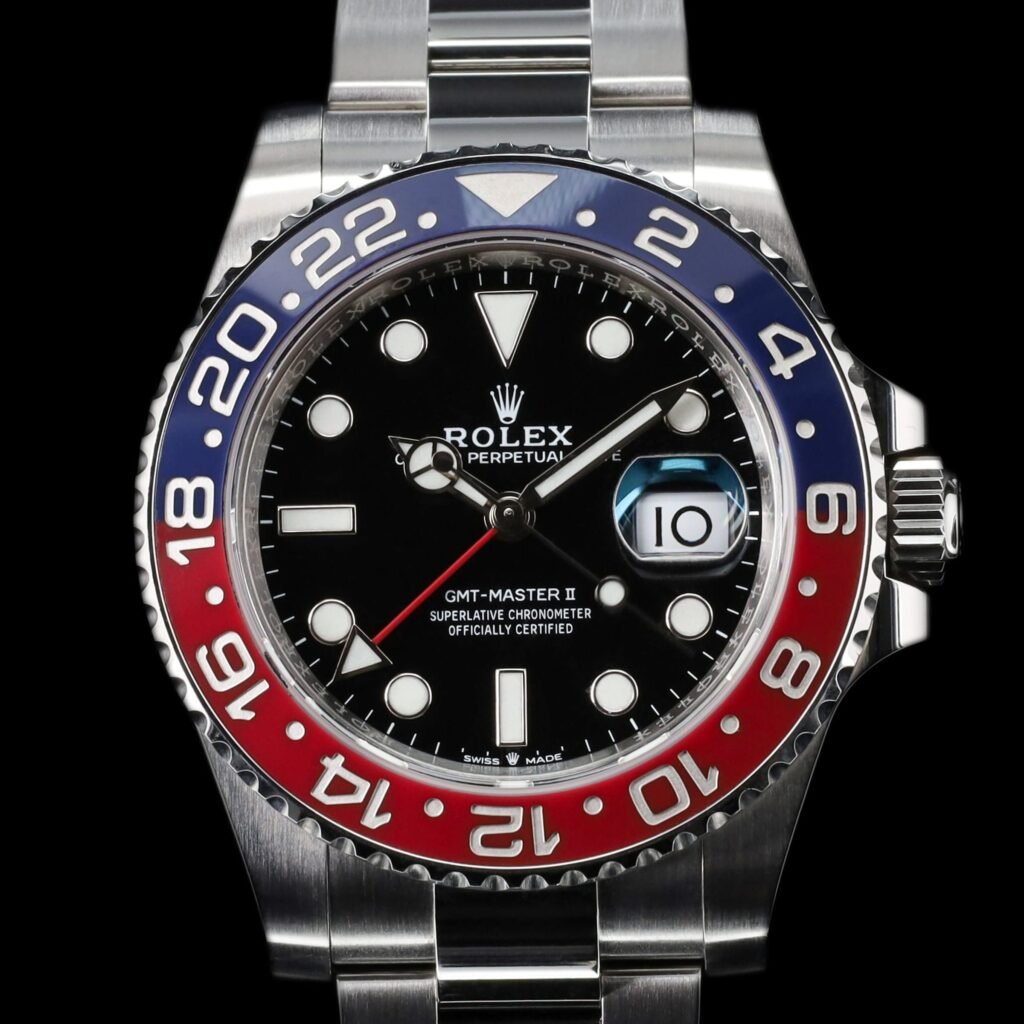
In 1954 Rolex introduced the GMT-Master, reference 6542, developed with Pan American World Airways for its crews. The idea was elegant. To an ordinary watch it added a fourth hand, which went round once every twenty-four hours instead of twelve, and a rotating bezel marked from one to twenty-four.
Set the extra hand to Greenwich time and you could read it against the bezel while the main hands showed local time. Turn the bezel by the right number of hours and the same hand could show a third zone. The bezel was coloured in two halves, red and blue, to separate the daylight hours from the night. That colour scheme later earned the watch its affectionate nickname, the Pepsi, and it has become one of the most recognisable bezels in watchmaking.
How it works
Every GMT watch has the same basic parts: hour, minute and seconds hands, plus a fourth hand that circles once a day, read against a 24-hour scale on the bezel or the dial. Because the fourth hand moves at half the speed of the ordinary hour hand, it can show the time of day in a second place without any confusion between morning and evening.
There are two kinds, and the difference matters to frequent travellers.
On a "travelling" GMT, sometimes called a true GMT, you can move the main hour hand forwards or backwards in one-hour jumps without stopping the watch. When you land in a new city you simply jump the local hour hand to the new time, and the minutes, seconds and home time are undisturbed. The date usually changes with it. Rolex added this function in 1982 with the GMT-Master II.
On an "office" GMT, sometimes called a caller GMT, it is the 24-hour hand that jumps independently. This suits people who stay put and need to keep track of colleagues or family in another zone. Both are useful; they simply suit different lives.
A watch for the Gulf
There are few places where a GMT makes more sense than the Gulf. The region is a crossroads between Europe, Asia and Africa, and many people who live here keep one foot somewhere else: a family in Cairo, a business in London, a university in Boston, a supplier in Shanghai.
The arithmetic is constant. Dubai and Abu Dhabi are four hours ahead of Greenwich, Riyadh, Doha and Kuwait three, and London either level with Greenwich or an hour ahead in summer. A GMT turns that mental arithmetic into a glance. It is why the complication is popular here among people who never fly a plane: one hand for where you are, one for where your heart is.
Beyond Rolex
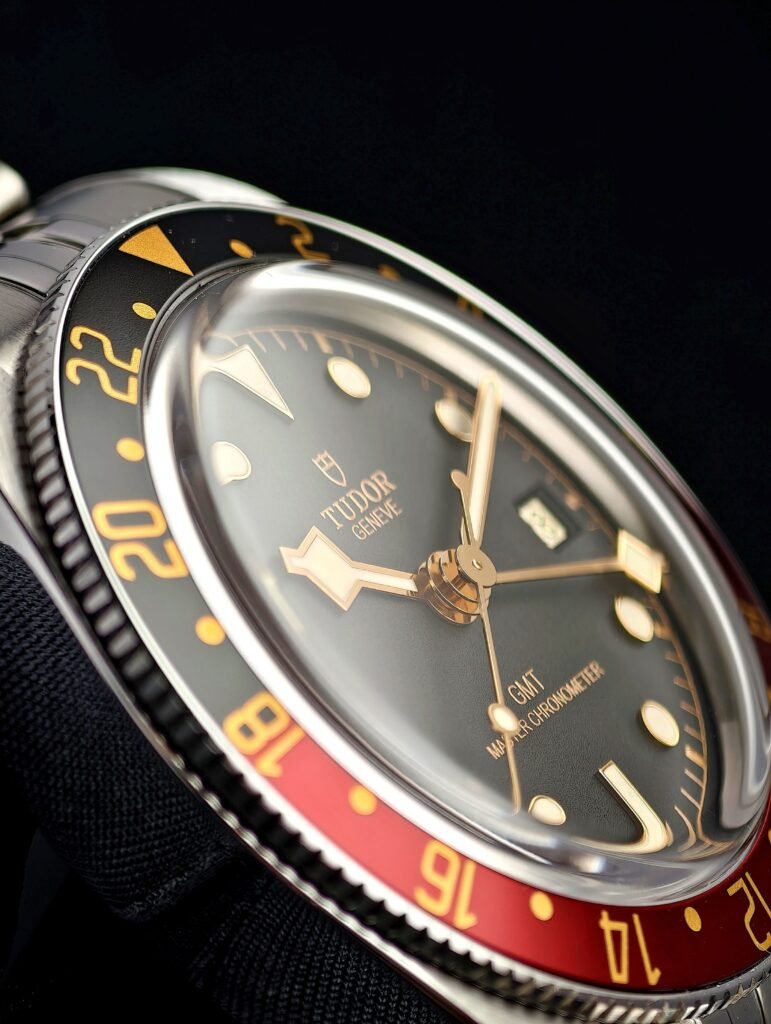
Rolex's design set the template, but almost every serious maker now offers a GMT, and the variety is wide. Some are sporty steel watches with bezels in blue and black, black and grey, or brown and black, each colour combination nicknamed by collectors. Others are dress watches that show the second time zone discreetly on the dial, without a rotating bezel at all.
World-time watches, which show all twenty-four zones at once using a ring of city names, are the GMT's more ambitious cousin. They tend to be more expensive and more delicate, and each zone is represented by a city chosen by the maker. On many of them, the zone four hours ahead of Greenwich is marked simply Dubai, a small sign of how central the Gulf has become to the way the world travels.
What to look for
If you are choosing a GMT, start with how you travel. If you fly often and want to change local time quickly on arrival, look for a travelling GMT with a jumping hour hand. If you mostly stay home and track another zone, an office GMT is fine and often less expensive.
Then consider legibility. The fourth hand should be easy to distinguish from the others, usually by colour, and the 24-hour scale should be clear in poor light. A bezel that rotates in both directions is more useful than one that turns only one way, which is a feature of dive watches.
Finally, think about the date. On a well-designed travelling GMT, the date follows local time when you jump the hour hand past midnight. On some cheaper designs it does not, and you may find yourself adjusting it by hand.
The quiet pleasure of it
There is something reassuring about a watch that keeps you in two places at once. It reminds you, at a glance, that it is late evening at home while you are in a bright afternoon somewhere else, and that someone there may already be asleep. Seventy years after it was made for pilots, the GMT has become something more personal: a small instrument for people whose lives span more than one place.